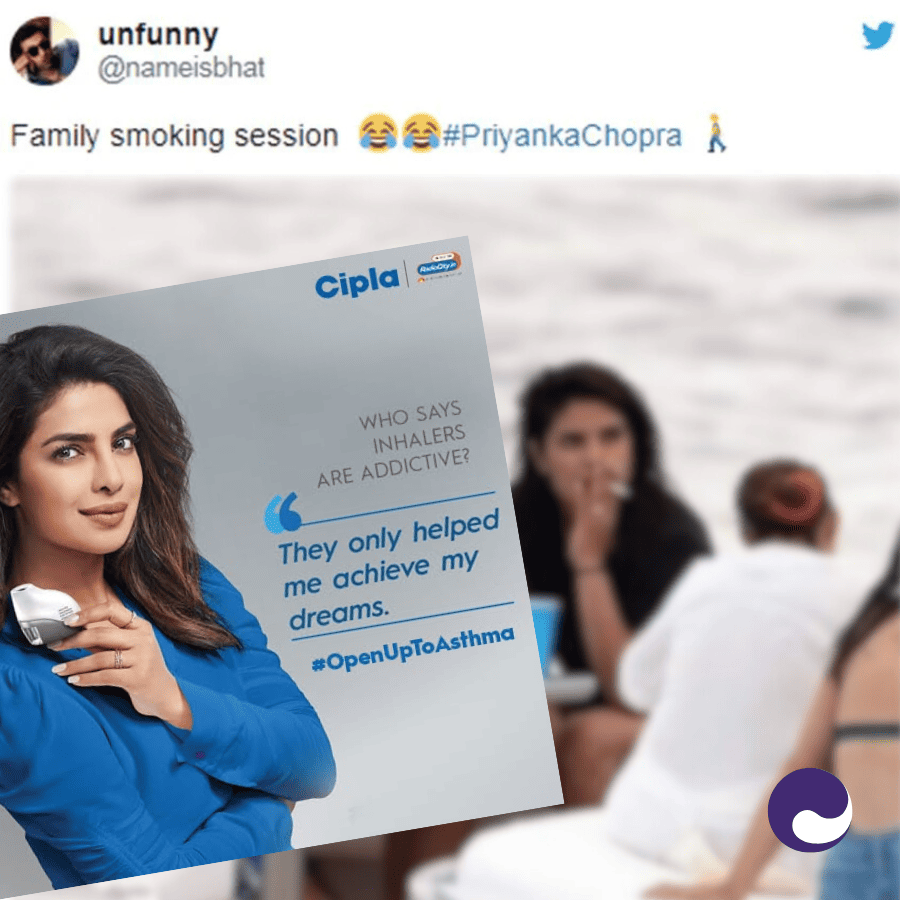
Priyanka Chopra began her partnership with Cipla Respiratory for the BreatheFree campaign (specifically the hashtag – BerokZindagi) in September 2018. The story behind her association with Cipla was that Priyanka was someone who was diagnosed with asthma at age 5 and she joined the campaign to break the stigma surrounding the condition and encourage the use of inhalers.
In one of Breathfree’s Facebook post it is mentioned that Priyanka Chopra found Asthma ‘challenging’ at work. Moreover in another post she discouraged or requested people not to light firecrackers at Diwali because of the effect it has on respiratory health. And surely all this was in positive light.
Then, in July 2019 a photograph of Priyanka Chopra surfaced smoking a cigarette while vacationing with her husband Nick Jonas and her mother on social media. It went viral. She was criticized for ‘hypocrisy’ because she had previously advocated against smoking and firecrackers and specifically promoting a campaign for asthma awareness while having disclosed, she suffered from the condition herself. Doubts were being raised on whether Priyanka Chopra actually asthmatic was as claimed.
#PriyankaChopra giving comments on diwali to not use firecrackers and all & I have asthma people like me suffer during diwali and blabla
— Anurag Tiwari (@Anurag2748) July 21, 2019
Pic 1. Firecrackers on her wedding
Pic 2. Smoking cigarette
Now this cigarette won't affect you and the firecrackers didn't harm to anyone pic.twitter.com/ZYYm8eRuaO
Nick when he saw Priyanka blowing sparkling candles 😂#PriyankaChopra pic.twitter.com/W9vsnzA5qv
— Sameer Suleman (@Imsameer_95) July 21, 2019
The controversy trended for several days. Cipla did not make a major public statement distancing from her, but eventually signed Indian actress Radhika Apte. This issue eventually faded, but it became one of the more talked-about celebrity-brand mismatch moments in India.
Celebrity endorsements in pharmaceutical marketing operate on a fragile psychological contract: authenticity. Unlike fashion or FMCG, pharma brands trade in trust, vulnerability and actual health experiences. When that authenticity cracks, the fallout is not merely reputational, but it is ethical.
All- Novo is still family, we agreed together to suspend diabetes activities for now. Thanks for the support!
— Paula Deen (@Paula_Deen) June 27, 2013
FUN FACT: Victoza® (the diabetes drug @Paula_Deen endorses) hasn't scrubbed her image from their site...yet. pic.twitter.com/YElz4zNyFM
— Temp X 💩 (@Tempdiaries) June 21, 2013
In a similar case Novo Nordisk signed Paula Deen (American chef, cookbook author, and TV personality) to endorse their brand Victoza. She became a paid spokesperson for the diabetes drug after revealing she had Type 2 diabetes. But Paula Deen is famous for butter-heavy cooking. Critics accused her of promoting unhealthy eating for years and then profiting from diabetes treatment. The campaign drew ethical criticism about conflict between lifestyle and medical advocacy. Novo Nordisk eventually faced PR discomfort amid the broader controversy.
What Pharma Marketers Must Learn
1. Pharma Should Focus on Trust Rather Than Aspiration
Most consumer brands sell aspiration such as “how you look”, “how you feel”, “how others see you”. Pharmaceutical brands, however, sell reassurance. Patients and caregivers are often anxious, confused, desperate or vulnerable. They are looking for reliability and honesty.
If a celebrity associated with a health condition behaves in a way that contradicts that condition, the disappointment feels personal. It does not feel like a marketing mistake. It feels like betrayal.
That is why alignment must go beyond popularity. The celebrity’s public behavior, lifestyle and values must genuinely match the health message being promoted.
2. Look Beyond Popularity and Study Patterns of Behavior
Before signing a celebrity, pharma companies should carefully examine the celebrity’s public history.
- Have they consistently behaved in a way that aligns with the health message?
- Do their past statements contradict the campaign theme? What about the future?
- Is their lifestyle likely to invite scrutiny?
This is not about judging a person’s character, but it is about understanding the risks.
For example, if someone known widely for unhealthy eating habits is endorsing a diabetes medication may raise questions. If someone advocates respiratory health but is later seen smoking, the public reaction will be sharp.
A simple background check is not enough. Companies need to think ahead: What could go wrong?
3. Do Not Build the Entire Message Around One Celebrity
When a campaign revolves entirely around one famous face, the brand becomes dependent on that individual’s reputation. If their image suffers, the campaign suffers.
A safer and stronger approach is to build a broader story:
- Include doctors and scientists to explain the science.
- Share real patient experiences.
- Provide educational resources.
- Partner with patient advocacy groups.
In this way, even if the celebrity faces criticism, the campaign still stands on solid ground.
The focus should remain on the disease and the patient … not on the star.
4. Be Ready for a Crisis Before It Happens
In healthcare, silence or delayed response can damage trust.
Pharma companies should prepare crisis response plans in advance. This includes:
- Deciding who will speak.
- Preparing clear and simple statements.
- Aligning legal, regulatory, and communication teams early.
When controversy breaks, the public watches how the brand reacts. A calm, transparent response can limit damage. Confusion or avoidance can make things worse.
Being prepared does not mean expecting failure. It means understanding that public perception can change overnight.
5. Understand the Ethical Weight of Healthcare Marketing
Even when a celebrity is part of a disease awareness campaign and not directly promoting a specific drug, their influence shapes how people think about treatment.
Healthcare decisions are serious. They affect money, lifestyle, and sometimes survival. When a celebrity appears inconsistent, it raises deeper ethical concerns — not just marketing questions.
Pharma brands must therefore ask:
- Does this campaign truly help patients?
- Does it encourage responsible behavior?
- Are we sending a balanced message?
Short-term attention should never come at the cost of long-term trust.
The Larger Reality
Many pharmaceutical companies adopt strategies from consumer marketing because they appear effective and modern. But healthcare is not the same as selling clothes or snacks.
In consumer industries, controversy sometimes increases visibility. In pharma, controversy reduces confidence. And when confidence drops, patients hesitate — not just about the campaign, but sometimes about treatment itself.
That is a risk no responsible healthcare brand should take.
Fame Cannot Replace Credibility
Celebrity endorsements can make a health condition more visible. They can start conversations. They can reduce stigma.
But they can also magnify contradictions.
Before entering such partnerships, pharmaceutical marketers must ask a harder question:
Not, “Will this celebrity attract attention?”
But, “If this partnership is questioned publicly, can we defend it with integrity?”
In healthcare, reputation is not just about brand image.
It directly affects how patients feel about seeking care, following treatment, and trusting medical advice.
And that makes every endorsement decision far more serious than it appears.
Our Take
Celebrity endorsements in pharmaceutical marketing can be very effective, but they must be handled with caution.
Pharmaceutical industry is different from other industries. When a clothing brand faces criticism, it may lose some image value. But when a healthcare brand faces criticism, it can lose all the trust. And trust is the foundation of any pharmaceutical company.
In the cases discussed earlier, the main problem was not the celebrity’s fame. Instead, it was the disconnect between what was being said and what was being perceived. When the message and the messenger do not match, people feel misled and cheated. The conversation shifts from awareness to uncertainty.
Today’s digital world moves fast. A single photograph or a statement can spread within minutes. Therefore, companies must assume that every brand collaboration should be examined closely. If there is even a small inconsistency, it can quickly become a major talking point.
At the same time, brands should remember that a celebrity should support the message and not become the message. In other words, the focus must always remain on the disease, the patient and the treatment. If the entire campaign depends on one famous face, the risk becomes much higher.
In addition, companies must think long term. A celebrity may bring quick attention. However, attention is not the same as trust. Trust is built slowly through consistent communication, expert voices, and real patient stories.
Finally, ethics should guide every decision. Pharmaceutical marketing is not just about visibility. It influences how people think about their health. Because of that, every endorsement must be able to stand up to public interrogation.
To sum up, celebrity endorsements can help spread awareness, but they should never replace credibility. Fame may attract attention in the short term, but only trust sustains a healthcare brand in the long run.